Finding Your Blueprint
Dec 02, 2025I am a student of entrepreneurship. For many years I studied the founders I thought I was supposed to become. The icons, disruptors, the ones who built billion-dollar companies by outworking, outsmarting, and outlasting everyone around them. I read their biographies, studied their habits, and copied their language. But no matter how deep I went, I could never see myself in their stories.
I went to business school from 2008 to 2012, during a time when entrepreneurship was being defined by scale and domination. Every case study was about Apple, Starbucks, Microsoft, or Disney. We studied the founders who broke rules, challenged norms, and scaled their ideas into massive corporations. Around the same time, the 2010s gave rise to a new generation of icons at Uber, Instagram, TOMS, Amazon, and platforms like Shark Tank made startups part of everyday conversation. Raising money, pitching to investors, winning market share. These were the stories we were taught to admire and these were the models we were expected to follow.
I thought I wanted to be like Steve Jobs, Mark Cuban, or Jeff Bezos. But there was always a part of me that could never see myself in them—not just because I didn’t look like them, but because I didn’t want to move through the world the same way. These founders were portrayed as lone geniuses, people who saw the future before anyone else did, who pushed their ideas through resistance and didn’t care what anyone thought. These characteristics were admired, even expected, and for a while I tried to believe I could become that kind of entrepreneur too.
But over time I started to question if that made sense for me. I wasn’t singularly focused on dominance or disruption. I wasn’t motivated by the idea of proving everyone wrong. I wanted freedom, but I also wanted connection. I wanted to build things that brought people together. I didn’t want to lead through force, I wanted to lead through care.
Initially, I chose a safer path. I joined a company that gave me just enough freedom to feel like I had autonomy, but with the security of a salary and the structure of a system. It worked for a while. But even then, I kept circling back to the same tension: I wanted to start my own company but I wasn’t sure if I could do it alone.
And maybe that’s because I didn’t have the right models.
The examples I was trained to study were built around a narrow version of success. They celebrated scale over depth, dominance over alignment, bravado over clarity. Since those were the only stories I saw, I started to believe that’s what entrepreneurship had to look like.
More recently I’ve had the privilege of working with dozens of creative entrepreneurs—artists, designers, educators, and builders. They’re not household names. Most of them aren’t pitching investors or chasing headlines. But they’ve built sustainable, honest businesses that reflect who they are and what they care about. Their companies may be small, but their impact is meaningful, generous, and lasting. They create value, provide for themselves and their families, and stay in alignment with who they are.
This is success, and these are the models we need more of.
We need more examples of real people building companies that match their values and their vision of the world. We need to highlight founders who are successful by their own definition, not someone else’s. We need stories of people who stayed close to their craft, built community through consistency, and figured out how to support others without losing themselves in the process.
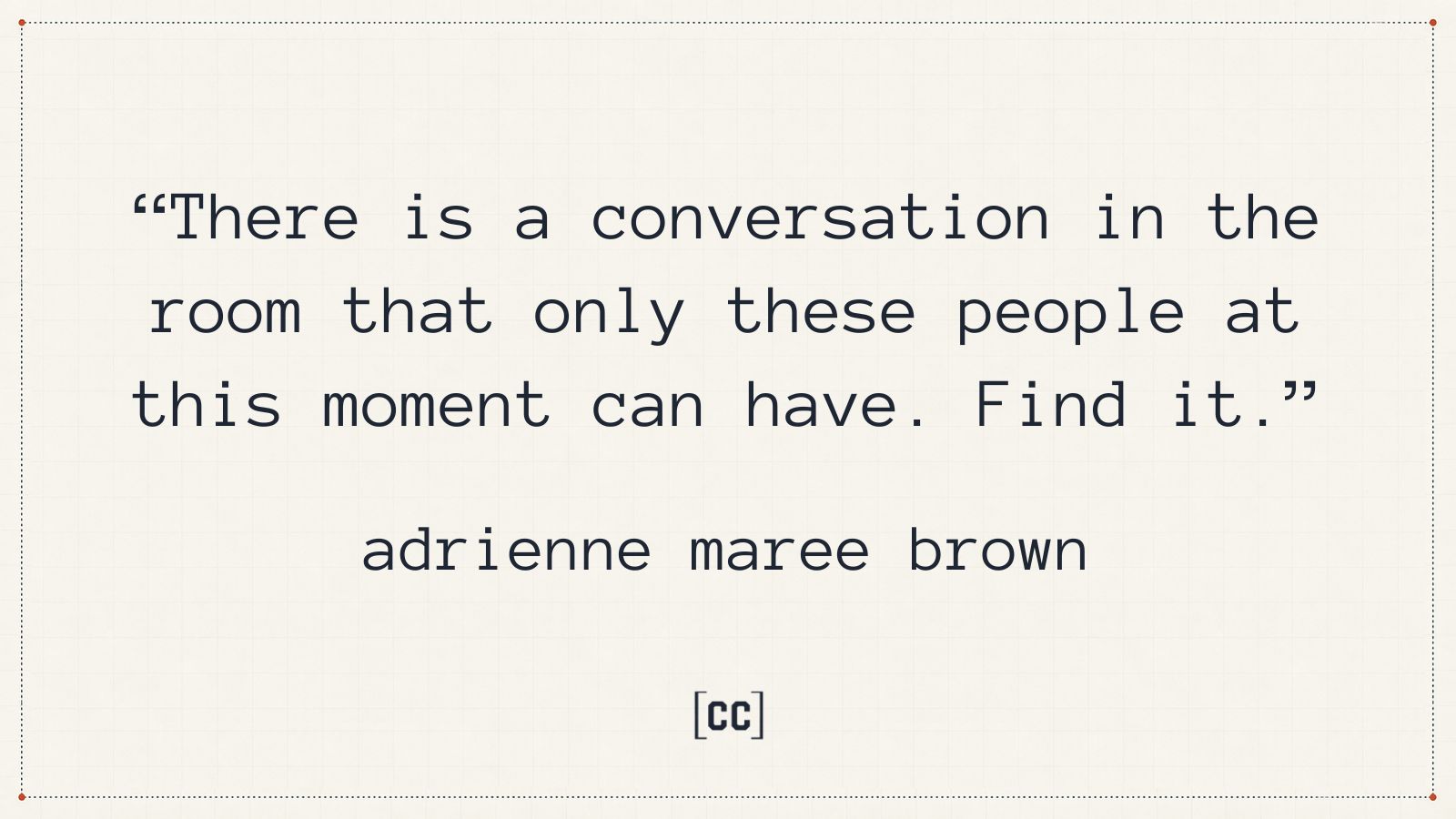
In the book Emergent Strategy, adrienne maree brown writes from her experience as a facilitator and movement builder. The work centers on the belief that change emerges not from controlling people or outcomes, but from listening closely to what’s alive in a moment. She writes: “There is a conversation in the room that only these people at this moment can have. Find it.”
The longer I’ve been in this space, the more I believe the best models aren’t found in case studies. They’re found in people we know. Friends, collaborators, and mentors who build slowly and with intention. They don’t fit the myth of the genius founder, but they’ve carved out space to do work that matters, in ways that feel true to who they are. You don’t have to dominate a market to build something meaningful. You just have to tune into what’s present and unfolding around you, and trust that your values will guide the work.
I’m proud to surround myself with founders that exhibit these characteristics. They are part of this Creators Creed community, and they are the new model of entrepreneurship for future generations.
If we only study the biggest companies and loudest voices, we miss the people building quiet revolutions all around us. We start measuring our path against stories that were never meant for us. And when that happens, we risk giving up not because we failed, but because we were following the wrong map.
So if the stories you were taught to follow don’t feel right anymore, it doesn’t mean you’re lost. It just means you need better models, the kind rooted in care, clarity, and connection. The kind you might already know, and the kind you are already becoming.
by